
G-TERCOA HELD ITS 4TH SUMMER SCHOOL WHICH DISCUSSED ARTIFICIAL INTELLIGENCE IN EDUCATION AND RESEARCH
Published at: January 28, 2026 Category: 2026, NewsThe Research Group on Weaving Cognitive Learning Networks (G-TERCOA/CNPq), linked to the Faculty of Education of the Federal University of Ceará (FACED/UFC-UFC), held its IV Summer School on January 22nd and 23rd, 2026, in person, at the Paulo Freire Auditorium at FACED/UFC, in Fortaleza, Ceará.
With the theme “Artificial Intelligence: innovating formative assessment and fostering quantitative research,” the event represented an important space for academic training, scientific dialogue, and knowledge sharing, bringing together researchers, teachers from Basic and Higher Education, undergraduate and graduate students interested in the possibilities and challenges of using Artificial Intelligence (AI) in education and research.
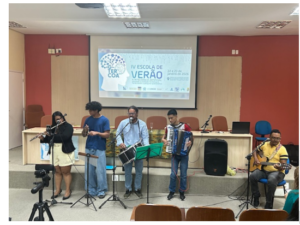
The program began on January 22nd at 8:00 AM with registration and a cultural presentation featuring the band Nepotismo, a musical group with a repertoire focused on MPB (Brazilian Popular Music), xote (a type of Brazilian folk music), and old-school forró (a type of Brazilian folk music), led by Professor José Erandy Vieira de Sousa, who collaborates with G-TERCOA’s initiatives.
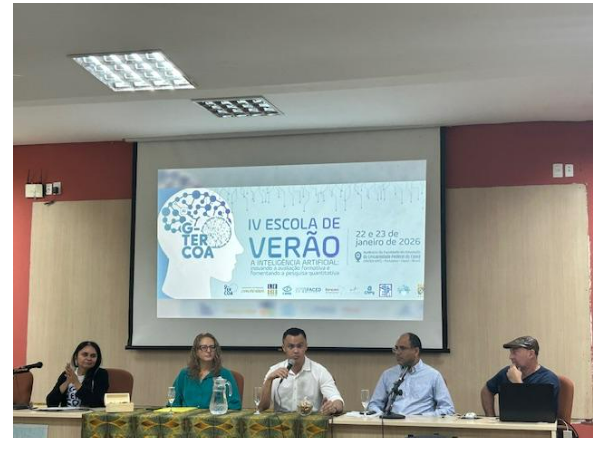
Next, the master of ceremonies, Prof. Me. Hemetério Segundo Pereira Araújo, proceeded to announce the members of the opening ceremony panel, which consisted of the director of FACED/UFC, Prof. Dr. Heulalia Charalo Rafante, Prof. Dr. Antonio Marcelo Araújo Bezerra (SEDUC/CE), Prof. Dr. Solonildo Almeida da Silva (IFCE/Fortaleza), and Prof. Dr. Maria José Costa dos Santos (UFC).
Throughout the first day, lectures were held that discussed the use of Artificial Intelligence tools in academic writing, emphasizing productivity with scientific and ethical responsibility, as well as the ethical challenges and possibilities of AI in education.
The first lecture was given by Prof. Dr. Francisco José de Aquino (IFCE-Fortaleza), moderated by Prof. Me. Italândia Ferreira de Azevedo (RENOEM-IFCE). The lecture was titled “Use of artificial intelligence tools in academic writing: co-pilots of productivity with scientific and ethical responsibility”.
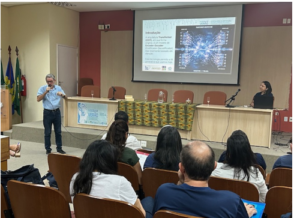
The event addressed the importance of AI literacy, the need to ensure computational ethics, and presented different tools to contribute to education, emphasizing the personalization of learning, ease of access to different resources, and the contributions of feedback that can be provided to students through these tools.
In the afternoon, at 2 pm, the event featured a presentation by Prof. Dr. José Wellington Franco da Silva (UFC/Campus: Crateús), moderated by the leader of G-TERCOA/CNPq-UFC, Prof. Dr. Maria José Costa dos Santos (UFC).
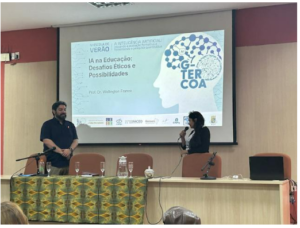
The lecture entitled “AI in Education: Ethical Challenges and Possibilities,” which addressed the topic from a socio-historical perspective, encompassing studies from the 20th century onwards, discussed the applicability of some AI tools for academic research, as well as the importance of implementing the Brazilian Artificial Intelligence Program (PBIA), which aims to transform the country into a protagonist in the field and not just a consumer of this technology, providing participants with a moment of valuable reflection.
In the late afternoon, the program included a lecture given by Prof. Dr. Antonio Marcelo Araújo Bezerra (SEDUC-CE), moderated by Prof. Dr. Roberto da Rocha Miranda (SEDUC-CE), entitled “The use of Artificial Intelligence as support for formative assessment practices,” in which reflections on AI as support for formative assessment practices and its implications in daily school and academic life were addressed.
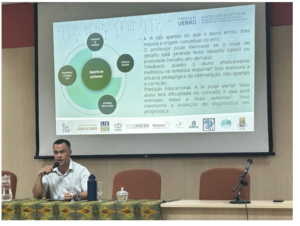
Also on January 22nd, at 6 PM, the lecture “AI: Between Diamonds and Sandwiches” took place, presented by Prof. Dr. José Rogério Santana (UFC), with mediation by Prof. Me. Arnaldo Dias (SEDUC-CE). The activity promoted a critical and provocative reflection on the meanings, metaphors, and impacts of Artificial Intelligence in contemporary society and in the educational field, encouraging the audience to think beyond the instrumental use of technology.
On the second day, January 23rd, activities began at 1:30 PM and featured the distinguished presence of Ana Maria Dias de Lima, director of the Union of Workers of Federal Universities in the State of Ceará (SINTUF-CE), Professor Dr. Hermínio Borges Neto (UFC), and Professor Angela Maria de Sousa Bezerra (Technical-Administrative Staff – UFC). The training session began with a cultural presentation led by Professor Arnaldo Dias (SEDUC-CE), who provided a literary delight with the reading of a poem entitled “Pedagogical Relationships: AI and Poetry,” allowing for moments of socialization and enjoyment.
In the afternoon, at 2 PM, Professors Wellington Gabriel Freitas de Oliveira and André Santos Silva led the lecture “AI for data-driven formative assessment: possibilities and limitations of its use,” moderated by Professor [Name missing]. Dr. Amsranon Guilherme Felicio Gomes da Silva (SEDUC-CE). The discussion highlighted the potential, ethical challenges, and limitations of using data and algorithms in educational assessment processes.
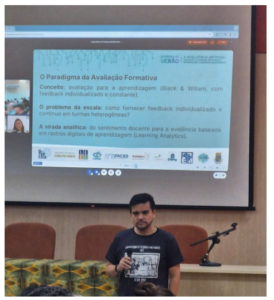
Continuing the program, at 3:30 PM, Professor Dr. Charlline Vladia Silva de Melo gave a lecture entitled “Artificial Intelligence and Quantitative Research: Potentialities, Limits, and Challenges,” moderated by Professor Dr. Marcelo Bezerra.
The lecture addressed the role of AI in scientific production, emphasizing its methodological contributions, as well as the necessary precautions in the use of these technologies in academic research, delving into the possibilities and limitations of using AI applied to quantitative research, highlighting its methodological limitations and challenges.
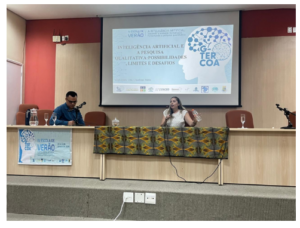
With these activities, the 4th G-TERCOA Summer School emphasized the group’s commitment to teacher training, pedagogical innovation, and the strengthening of scientific research, promoting current and necessary reflections on AI in the educational field.
The closing of the 4th Summer School 2026 was marked by the presentation of postdoctoral internship reports by Prof. Dr. Gleissiane Coeli Freitas Batista Prata and Prof. Dr. Antonio Marcelo Araújo Bezerra, highlighting G-TERCOA’s commitment to scientific production and the ethical, socially committed, and responsible training of researchers.
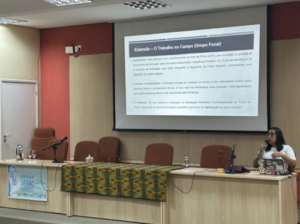
During this event, Prof. Dr. Gleissiane Coeli Freitas Batista Prata presented the activities developed during her postdoctoral studies and highlighted the importance of researchers having a socio-historical-cultural perspective on their object of study, understanding research as something we experience.
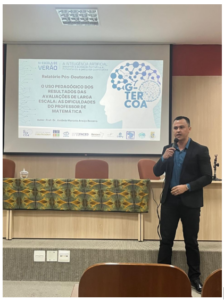
Professor Dr. Antonio Marcelo Araújo Bezerra presented his contributions and studies developed during this period, highlighting the reflection on how data from large-scale assessments could help Basic Education teachers overcome their difficulties in the teaching-learning process in mathematics.
The holding of the IV Summer School strengthens the role of G-TERCOA/CNPq as a reference space in promoting debates on education, digital technologies, formative assessment and research, contributing to the critical and ethical training of teachers and researchers in the face of the challenges of using Artificial Intelligence in the educational context.
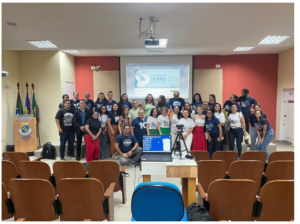
Source: Comunication Team of the Study and Research Group Weaving Cognitive Learning Networks (G-TERCOA/CNPq–UFC).
Playlist on Youtube: Click here!